Author: baawa

  • How to Avoid Fake Watches in Nigeria: A Buyer’s Checklist

    How to Avoid Fake Watches in Nigeria: A Buyer’s Checklist

    That excitement when you finally save up enough to buy a quality timepiece. You picture yourself walking into a meeting, sleeve rolled just right, watch gleaming on your wrist. Then reality hits: the watch you bought for “original price” starts losing time after two weeks. The gold plating peels. The strap breaks.

    Nigeria’s watch market is flooded with counterfeits. From busy markets in Lagos to online stores promising “authentic luxury,” fake watches have become so sophisticated that even experienced buyers get fooled. The frustrating part is that you cannot always tell the difference just by looking.

    This guide gives you a practical checklist to protect yourself before you hand over your hard-earned money. Every tip here comes from real scenarios Nigerian buyers face daily, and by the end, you will know exactly what to look for, what questions to ask, and which red flags should make you walk away.

    Why Fake Watches Are So Common in Nigeria

    The demand for stylish watches in Nigeria has never been higher. From young professionals wanting to make an impression to business owners who understand the power of a good first impression, watches remain one of the most sought-after accessories. This high demand, combined with limited access to official brand stores, creates perfect conditions for counterfeiters to thrive.

    Most fake watches enter Nigeria through unofficial import channels. Some look almost identical to the real thing on the surface, but the materials, movements, and craftsmanship tell a different story. The consequences go beyond wasted money. A watch that stops working during an important meeting or one that turns your wrist green damages your confidence and your image.

    Understanding where these fakes come from helps you stay alert. Markets, social media vendors with suspiciously low prices, and even some physical stores stock counterfeits alongside genuine pieces. The sellers often do not even know the difference themselves.

    The Weight and Feel Test

    Genuine quality watches have a certain heft to them. This is one of the first things you should check, and it requires no expertise at all. Pick up the watch. Does it feel substantial? Or does it feel like something you would find in a children’s toy section?

    Authentic timepieces use materials like stainless steel, sapphire crystal, and quality leather or metal for straps. These materials add weight. Counterfeit watches typically use cheaper alloys, plastic components disguised as metal, and thin glass instead of crystal. The difference is noticeable once you know what to feel for.

    Run your fingers along the edges of the case. Quality watches have smooth, precise finishing. If you feel rough edges, uneven surfaces, or anything that catches your skin slightly, that is a warning sign. The details matter because manufacturers who cut corners on finishing almost certainly cut corners on the movement inside.

    Examine the Movement and Second Hand

    The movement is the heart of any watch, and observing the second hand can tell you a lot about what is inside. On most quality quartz watches, the second hand moves in smooth, precise ticks. On mechanical watches, the sweep is continuous and fluid, almost like the hand is gliding around the dial.

    Fake watches often have jerky, inconsistent second hand movements. The ticking might be uneven, or the hand might pause slightly at certain points. This happens because counterfeiters use the cheapest movements available, often ones that cannot maintain consistent power delivery.

    If the seller allows it, ask to see the caseback. Some watches have transparent backs that let you see the movement. A genuine quality movement will have fine finishing, proper jewels, and engraved markings. Counterfeit movements look rough, with visible tool marks and generic, sometimes misspelled, engravings. According to the Federation of the Swiss Watch Industry, genuine Swiss movements must meet strict quality standards that counterfeits simply cannot replicate.

    Check the Dial and Printing Quality

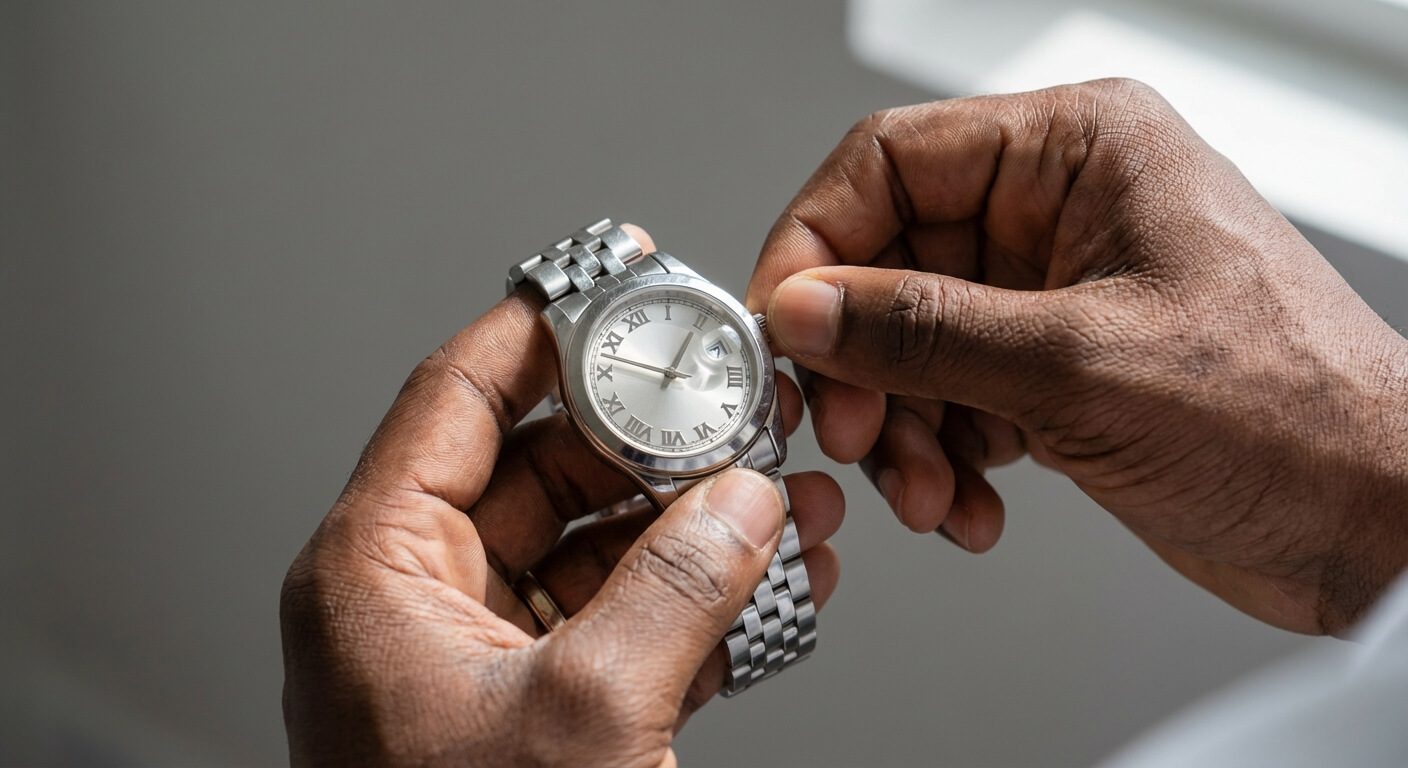
    Bring the watch close to your eyes and look at the dial carefully. Every letter, number, and logo on a genuine watch will be perfectly printed. The fonts are consistent, the spacing is exact, and the colours are uniform. Counterfeiters struggle to replicate this level of precision.

    Look for these specific issues: smudged text, uneven letter spacing, misaligned logos, or printing that looks slightly fuzzy at the edges. The date window, if present, should display numbers that are perfectly centred. A number that sits too high, too low, or at an angle indicates poor quality control.

    Brand logos deserve special attention. Compare what you see with official images from the brand’s website. Counterfeiters often get small details wrong. A crown logo might have the wrong number of points. Letters might be slightly thicker or thinner than they should be. These differences seem minor until you know to look for them.

    Verify the Seller’s Reputation and Documentation

    Where you buy matters as much as what you buy. A seller with a physical location, a verifiable business registration, and a track record of satisfied customers presents far less risk than an anonymous social media account.

    Ask for documentation. Genuine watches come with warranty cards, certificates of authenticity, user manuals, and proper packaging. The paperwork should match the watch’s serial number. If a seller cannot provide these documents or offers excuses about why they are missing, treat that as a major red flag.

    Customer reviews and testimonials provide another layer of verification. Look for reviews that mention specific details about the buying experience, the product quality, and the after-sales service. Generic, overly positive reviews with no specifics often come from fake accounts. Trusted retailers like BaaWA Accessories maintain their reputation by ensuring every piece they sell meets quality standards and comes with proper documentation.

    Price as a Warning Signal

    If a deal looks too good to be true, it almost always is. Quality watches cost what they cost because of the materials, engineering, and craftsmanship involved. A seller offering a watch at 70% below market price is not giving you a bargain. They are selling you a fake.

    Research the typical price range for the watch you want before you start shopping. The Hodinkee Watch 101 Guide provides excellent resources for understanding what different types of watches should cost. When you have this knowledge, you can immediately spot prices that do not add up.

    Some sellers justify low prices with stories about “wholesale connections” or “customs seizures.” These narratives are almost always fabricated. Legitimate businesses cannot sustainably sell genuine products at prices that would put them at a loss.

    Your Pre-Purchase Checklist

    Before you pay for any watch, run through this checklist:

    • Weight test: Does the watch feel substantial and well-made?
    • Finishing inspection: Are all edges smooth with no rough spots?
    • Second hand observation: Does the movement appear consistent and precise?
    • Dial examination: Is all text perfectly printed with proper spacing?
    • Logo verification: Does the brand logo match official images exactly?
    • Documentation request: Can the seller provide warranty cards and certificates?
    • Price comparison: Is the price within the normal market range?
    • Seller verification: Does the seller have a physical address and positive reviews?

    Going through these steps takes only a few minutes but can save you from weeks of regret. Make it a habit every time you consider buying a watch.

    Wrap-up

    Protecting yourself from fake watches requires a combination of knowledge and vigilance. The counterfeit market thrives because buyers often do not know what to look for until it is too late. With the checklist above, you now have practical tools to separate genuine quality from clever imitations.

    A quality watch is an investment in your image and confidence. It deserves the same careful consideration you would give any significant purchase. Take your time, ask questions, and never let pressure or excitement override your judgment.

    Ready to shop with confidence? Browse the collection of authentic watches in Nigeria at BaaWA Accessories, where every timepiece comes with proper documentation and quality you can trust.

  • Quartz vs. Automatic Watches: Which Movement is Best for You in Nigeria?

    You’ve finally decided to invest in a quality wristwatch. Good move. But now you’re stuck between two options: quartz or automatic. Both have their loyal fans, and both have been on wrists for decades.

    Here’s the thing—choosing between these two movement types is less about which one is “better” and more about which one fits your lifestyle, budget, and personal taste. A Lagos banker might have different priorities from an Abuja creative, and that’s perfectly fine.

    This guide breaks down everything you need to know about quartz and automatic watches so you can make a confident choice that you won’t regret six months from now.

    Understanding How Each Movement Works

    Before comparing, let’s get clear on what’s actually happening inside these watches. When you explore automatic watches in Nigeria, you’re looking at timepieces powered by your own movement. A rotor inside the watch spins as your wrist moves throughout the day, winding the mainspring and storing energy. No battery needed. It’s mechanical engineering at its finest.

    Quartz watches in Nigeria, on the other hand, run on battery power. A small battery sends an electrical current through a tiny quartz crystal, which vibrates at a precise frequency—exactly 32,768 times per second. This vibration drives the motor that moves the watch hands. Simple, reliable, and remarkably accurate.

    The difference in how they work affects everything else: accuracy, maintenance, price, and even the “feel” of wearing them.

    Accuracy: Quartz Takes the Lead

    If keeping perfect time matters most to you, quartz wins this round convincingly. A typical quartz watch loses or gains only about 15 seconds per month. Some high-end quartz movements are even more precise, staying accurate within a few seconds over an entire year.

    Automatic watches, despite their craftsmanship, can’t match this. Even a well-maintained automatic might drift by several seconds daily. Over a month, you could be looking at a minute or two of deviation. For most people, this isn’t a deal-breaker. But if you’re someone who needs exact timekeeping for work—say, coordinating meetings across time zones or tracking billable hours—quartz offers peace of mind.

    That said, there’s something to consider. The accuracy of mechanical watches has improved dramatically in recent decades, with some certified chronometers performing remarkably well.

    Maintenance and Long-Term Costs

    Your watch will need attention over time. The question is: how much?

    Quartz watches are low-maintenance by design. Replace the battery every two to three years—a quick and affordable process—and you’re good. Most watch shops in Lagos, Abuja, or Port Harcourt can handle battery replacements in minutes. Unless you damage the watch physically, you won’t need to think much about upkeep.

    Automatic watches demand more care. Experts recommend servicing them every three to five years. This involves disassembling the movement, cleaning and lubricating components, replacing worn parts, and reassembling everything. It’s skilled work, and it costs accordingly. A proper service can run anywhere from ₦30,000 to well over ₦100,000, depending on the brand and complexity.

    Here’s where it gets interesting though. A well-maintained automatic watch can last generations. Your grandfather’s automatic Seiko from 1975 can still run beautifully today with proper care. Quartz watches, while reliable, don’t carry that same heirloom potential. The movements are typically replaced rather than repaired, and the emotional value of passing down a battery-powered watch feels different.

    Price Points: What Your Budget Gets You

    Money talks, so let’s address it directly.

    Entry-level quartz watches start remarkably low—you can find decent options under ₦15,000. Mid-range quartz pieces with respected brand names sit comfortably between ₦30,000 and ₦80,000. Premium quartz watches with superior build quality and design can reach ₦150,000 or higher.

    Automatic watches generally cost more. The mechanical complexity justifies this. Budget-friendly automatics start around ₦50,000, with mid-range options typically falling between ₦100,000 and ₦300,000. Luxury automatic timepieces? Those can easily exceed ₦500,000 and climb into the millions.

    But don’t think of this purely as expense. Think about it as investment versus purchase. Certain automatic watches hold their value exceptionally well. Some even appreciate over time, especially limited editions or pieces from prestigious manufacturers. The watch investment market has grown substantially, with collectors treating quality timepieces as alternative assets.

    The Value Equation for Nigerian Buyers

    Consider your earning trajectory. If you’re building your career and need a reliable everyday watch right now, a quality quartz piece makes practical sense. You get excellent performance without straining your finances. As your income grows, you can add an automatic to your collection for special occasions or as a statement piece.

    Already established professionally and looking for something with presence? An automatic watch signals success in ways that quartz simply doesn’t—fair or not, that’s the perception in most business circles.

    Style, Prestige, and What Your Watch Says About You

    Let’s be honest about something. In Nigeria’s business and social scenes, what you wear matters. Your watch often speaks before you do.

    Automatic watches carry a certain prestige. The sweeping second hand (rather than the ticking motion of quartz), the weight on your wrist, the knowledge that dozens of tiny components are working in harmony—these details matter to watch enthusiasts and observant colleagues alike. Walk into a meeting with a visible automatic timepiece, and it communicates something about your taste and attention to quality.

    Quartz watches have their own appeal though. Many contemporary designs are sleek, modern, and sophisticated. They’ve shed the “cheap alternative” reputation they once had. High-end quartz pieces from respected brands look every bit as impressive as their mechanical counterparts to the average observer.

    Your personal style should guide this decision. Do you appreciate tradition, craftsmanship, and mechanical artistry? Automatic fits naturally. Do you prefer clean efficiency and modern practicality? Quartz aligns better with that mindset.

    Lifestyle Considerations for Nigerian Weather and Conditions

    Nigeria’s climate presents real considerations for watch owners. Heat, humidity, and dust can affect timepieces—some more than others.

    Quartz watches generally handle environmental stress better. Fewer moving parts mean fewer things that can go wrong. The sealed battery compartment and simpler construction make them more resilient to humidity and temperature fluctuations. If your work takes you outdoors frequently or you’re often in non-air-conditioned spaces, quartz offers practical advantages.

    Automatic watches require slightly more consideration. Extreme temperature swings can affect lubricants inside the movement. Dust and particles pose risks to the delicate components. That said, quality automatic watches from reputable manufacturers are built to handle real-world conditions. The water resistance ratings on modern timepieces have improved significantly, offering protection beyond what most people need.

    One practical note: automatic watches need regular wearing. Leave one in a drawer for weeks, and it stops. You’ll need to reset the time and date when you pick it up again. Quartz watches keep ticking whether you wear them daily or monthly.

    Making Your Decision

    Choose quartz if:

    • Accuracy matters greatly for your work or lifestyle
    • You want minimal maintenance hassle
    • Your budget is tighter right now
    • You rotate between multiple watches and can’t wear one daily
    • Practicality trumps tradition in your priorities

    Choose automatic if:

    • You appreciate mechanical craftsmanship and heritage
    • You want a timepiece that could become an heirloom
    • The prestige factor matters in your professional environment
    • You’ll wear the watch regularly enough to keep it running
    • You’re willing to invest in proper maintenance over time

    Neither choice is wrong. Both can serve you excellently for years.

    Wrapping Up

    Quartz and automatic movements each bring genuine strengths to your wrist. Quartz delivers unmatched accuracy and convenience. Automatic offers tradition, craftsmanship, and a certain emotional satisfaction that battery-powered watches rarely match.

    Your ideal choice depends on how you live, work, and what you value in the accessories you wear. Think about your daily routine, your professional environment, and what genuinely appeals to you beyond what others might think.

    Ready to find your perfect timepiece? Browse the collection of automatic watches and quartz watches at BaaWA Accessories to discover quality options that match your style and budget.