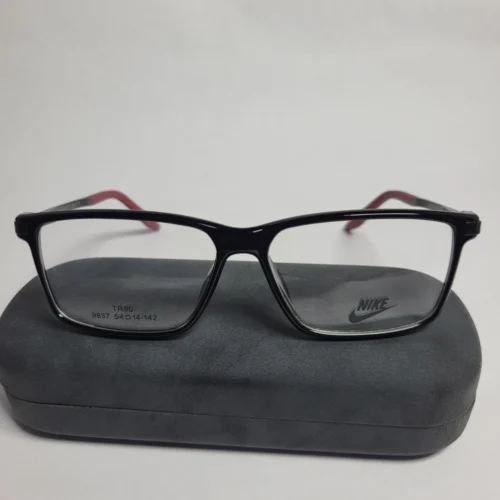
Your signature look is just a click away. Before you go, take a look at these exclusive markdowns on our top-rated wristwatches and designer eyewear.
Premium quality doesn't have to break the bank. Secure your favorite accessories today with safe bank transfers and reliable delivery across all 36 states in Nigeria.
A glasses prescription can look like a secret code. A grid of boxes, plus and minus signs, and Latin abbreviations that mean nothing at first glance.
It is far friendlier than it looks. Learning how to read your glasses prescription turns that confusing card into something you fully understand, so you can order lenses online, compare quotes and spot mistakes before they cost you.
This guide walks through every part of a standard prescription in plain language, using the same terms your optometrist and any good lens lab will use.
Why Reading It Yourself Pays Off
Understanding your own prescription puts you in control of every eyewear purchase. When you can read the numbers, you can order the correct lenses online with confidence, check that a store has entered your details properly, and avoid the small errors that lead to blurry, uncomfortable glasses.
It also makes reordering simple, since you can reuse a valid prescription across new frames without a fresh guessing game each time. You can apply what you learn here directly to the prescription glasses range in Nigeria, matching your numbers to the right lenses. For an authoritative breakdown of the same terms, the American Academy of Ophthalmology is a solid reference.
The Two Rows: OD and OS
Your prescription has two main rows, one for each eye, labelled with Latin abbreviations. OD stands for oculus dexter, meaning your right eye, and OS stands for oculus sinister, meaning your left eye. If you see OU, that refers to both eyes together, though it is less common on a standard glasses prescription.
Each eye can carry a different power, which is completely normal, so always read across each row separately to get the full picture for that eye. Getting the rows right is the foundation for everything else on the card, so take a second to confirm which line belongs to which eye before you read further.
SPH: The Main Lens Power
SPH, short for sphere, is the core strength of the lens, measured in units called dioptres. A minus sign in front of the number means you are short-sighted, so distance looks blurry, while a plus sign means you are long-sighted, so close-up looks blurry. The larger the number, the stronger the correction, which is why a reading of minus one is mild and minus five is strong.
This is the single most important figure on your prescription, since it sets the baseline power for each eye. Read it first, note the sign as well as the number, and the rest of the card builds on it.
CYL and Axis: For Astigmatism
If your eye has astigmatism, meaning the cornea is shaped a little more like a rugby ball than a football, two more values appear together. CYL, short for cylinder, is the extra power needed to correct that uneven shape, and a blank CYL box simply means you have no astigmatism to correct.
Axis is the partner to CYL, a number from 1 to 180 that tells the lab the exact angle at which to place the cylinder correction. The two always travel as a pair, so if you have a CYL figure you will always have an axis beside it. Together they fine-tune your vision beyond the basic sphere power.
ADD: For Reading and Progressives
ADD is the extra magnifying power added to the lower part of the lens for reading. It appears on prescriptions for bifocal, progressive or reading glasses, usually as a single plus value applied to both eyes. If your card shows an ADD figure, your prescription supports a multifocal or a dedicated reading lens.
This is the number that lets one pair of glasses handle both distance and near vision, which is a real convenience as reading vision changes with age. If the box is empty, your prescription is for a single distance power only.
PD: The Measurement Many People Forget
PD, or pupillary distance, is the gap between the centres of your pupils, measured in millimetres. It centres each lens exactly over your eye, which is why it matters so much for comfort. Many prescriptions leave it off, so ask your optometrist for it, or have it measured, before you order online.
An accurate PD is the difference between glasses that feel natural and glasses that feel slightly wrong all day, even when the power is correct. Treat it as an essential part of your details rather than an optional extra, especially for any online order.
Prescription Terms at a Glance
Term
What it means
OD / OS
Right eye / left eye
SPH
Main lens power, minus for short sight and plus for long sight
CYL
Extra power to correct astigmatism
Axis
Angle for the cylinder correction, from 1 to 180
ADD
Added power for reading or progressive lenses
PD
Pupillary distance, measured in millimetres
A Quick Worked Example
Say your card reads OD minus 2.00, minus 0.75 x 90, and OS minus 1.75, with a PD of 63. Reading it back, your right eye needs a moderate short-sight correction of minus 2.00, plus a small astigmatism correction of minus 0.75 set at an angle of 90 degrees. Your left eye needs a milder minus 1.75 with no astigmatism, since no CYL or axis is listed beside it.
The PD of 63 millimetres then centres both lenses over your pupils. With that single line decoded, you could place an accurate online order in minutes, which shows how quickly the code becomes plain once you know the parts. Keeping your eyes tested on schedule also keeps the numbers current, as the American Optometric Association advises.
What This Means For You
Put together, reading your prescription is a simple, repeatable routine. Take one eye at a time, start with SPH for the main power, add CYL and axis if astigmatism is present, note any ADD for reading, and confirm your PD. In a couple of minutes you will have understood the whole card.
With those numbers in hand, you can order accurate lenses online without a single guess, check any quote for errors, and reuse the same details across new frames until your next eye test. That confidence saves money and spares you the frustration of a pair that never feels quite right. Share your full numbers with the store, and your lenses will be made exactly for your eyes. Keeping a photo of the card on your phone means you can reorder in seconds whenever you find a new frame you love.
Wrap-up
Knowing how to read your glasses prescription puts you firmly in charge of every eyewear purchase. SPH sets the power, CYL and axis handle astigmatism, ADD covers reading, and PD centres it all over your eyes.
Read one eye at a time, note every figure, and keep your card safe for reorders. Do that and ordering the right lenses becomes quick, accurate and stress-free.