Your signature look is just a click away. Before you go, take a look at these exclusive markdowns on our top-rated wristwatches and designer eyewear.
Premium quality doesn't have to break the bank. Secure your favorite accessories today with safe bank transfers and reliable delivery across all 36 states in Nigeria.
How to Avoid Fake Watches in Nigeria: 6-Step Buyer’s Checklist (2026)
Learn how to spot fake watches in Nigeria with this step-by-step buyer's checklist. Inspect the dial, weight, movement, caseback, and seller before you pay so you never lose money to a counterfeit again.
Walk into any major market in Lagos or Abuja, and you will see them. Rows of shiny watches lined up like they just rolled off a luxury factory floor. Names you recognise. Prices that feel like a miracle. And the seller, smiling, swearing on his mother’s name that the piece is original.
Most of those watches are fake. Some are good fakes. Some are very bad fakes. Either way, your money disappears the moment you wear one outside the shop.
Learning how to spot fake watches in Nigeria takes a few minutes, a calm head, and the right checklist. Get this right, and you stop wasting money on plastic dressed up as Swiss steel.
Crisp, sharp dial printing with a perfectly centred logo
Blurry text, tilted fonts, or an off-centre logo
Heavy, balanced feel of solid steel, titanium, or gold
Light, hollow, toy-like weight in the palm
Soft, whisper-quiet tick or smooth sweeping seconds
Loud, plastic, sharp ticking sound
Sharp, grooved engravings on the caseback
Flat, printed, or generic caseback
Crown clicks into each position with quiet resistance
Crown feels gritty, loose, or completely empty
Solid bracelet links with a snap-tight clasp
Rattling links and a stapler-like clasp
Box, papers, and a serial number that matches the watch
No paperwork or mismatched/missing serial numbers
Quick scan: spotting a real vs fake watch in Nigeria before you pay.
Why This Matters
A watch is one of those purchases people quietly judge. Walk into a meeting wearing a wristpiece that screams counterfeit, and the room reads it before you say hello. Beyond reputation, fakes break easily, lose their polish within months, and have no resale value. The money you spent vanishes the day the strap snaps.
This is why building a quick inspection habit before you pay matters. Whether you are eyeing a piece from a market stall or browsing curated Watches Nigeria collections online, the same checks apply. Original timepieces are made with such care that the small details give them away. Fakes can mimic the look from a distance. They cannot mimic the feel, the finishing, or the engineering up close.
What to Inspect Before You Pay
Connecting that mindset to action, here is what your eyes, fingers, and ears should be checking on every watch before any money changes hands. Treat this as your pre-payment scan. A genuine stainless steel watch will feel a certain way in your palm, look a certain way under shop lighting, and tick a certain way at your ear.
Dial printing, fonts, and logo alignment
Weight and the cool feel of real metal
Movement sound (loud ticks are usually a red flag)
Caseback engravings, serial numbers, and hologram stickers
Crown action and how the hands respond to winding
Bracelet links, end-pieces, and clasp finishing
Box, papers, warranty card, and the seller’s reputation
The Step-By-Step Inspection: How to Spot Fake Watches in Nigeria
Step 1: Study the Dial Under Good Light
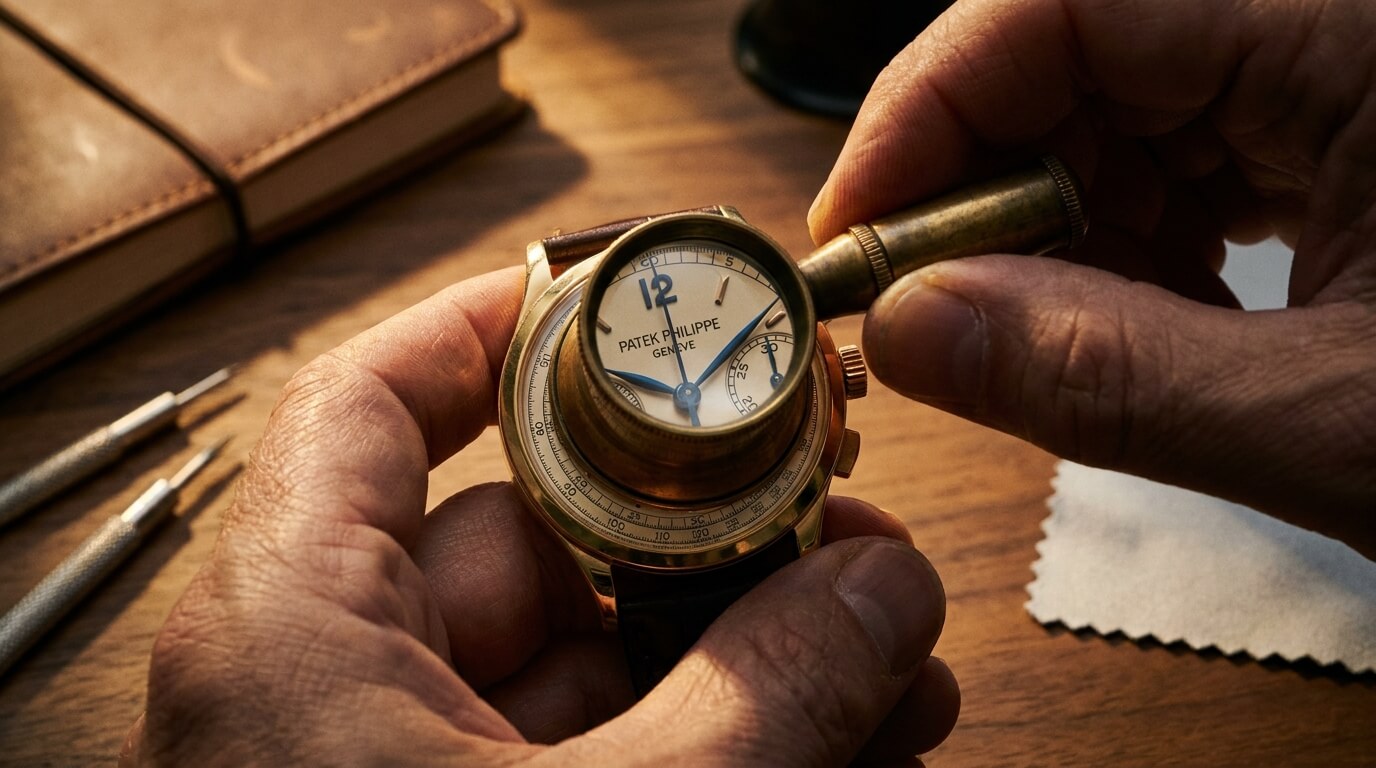
Start where your eyes naturally land. The dial. Tilt the watch toward strong natural light and look for crisp printing, properly spaced numerals, and a logo that sits perfectly centred. Authentic dials carry sharp markings with no smudges, no fuzzy edges, and no leaning fonts. Watch authentication experts at Bob’s Watches note that even the best counterfeits often fail this simple visual test.
Counterfeits cut corners on print quality because they rely on volume. If letters look slightly tilted, if the seconds track is uneven, or if the date wheel sits a hair off-centre, walk away. Real watchmakers do not let that kind of work leave the factory.
Step 2: Feel the Weight in Your Palm
Once the dial passes, lift the watch off the counter. Genuine pieces carry the heft of solid steel, titanium, or gold. Lift one of those, and you can feel why the brand charges what it charges. A fake feels light, hollow, and almost toy-like. Some counterfeits pack lead chips inside the case to fake heft, but the balance still feels off. Trust your hand.
Step 3: Listen to the Tick
Bring the watch close to your ear in a quiet corner of the shop. A quartz movement should produce a faint, almost shy tick. An automatic movement should be even quieter, with a soft sweep rather than a hard tick. If you hear a loud, plastic, sharp ticking sound, the movement inside is the cheap kind no matter what the dial says. Genuine movements are engineered to whisper.
Step 4: Inspect the Caseback and Serial Number
Flip the watch over. The caseback should carry sharp engravings, brand names cut cleanly into the metal, and a serial number that matches the warranty card or the box. The same standard shows up on authentic men’s luxury watches, where the caseback is treated as part of the finished piece rather than an afterthought.
Run your fingertip across the engravings. Real ones feel grooved and defined. Fakes often feel printed, raised, or worse, completely flat. If a watch claims to be a known brand but the caseback is plain or features a generic glass display with cheap-looking parts behind it, you are holding a counterfeit.
Step 5: Test the Crown and Bracelet
Pull out the crown. It should slide out smoothly and click into each position with a confident feel. Try winding it. A real movement winds with quiet resistance. A fake feels gritty, loose, or completely empty.
Move on to the bracelet. Each link should be solid, with no rattling, no rough edges, and no flimsy pin sticking out. Flip the clasp. Genuine clasps lock with a satisfying snap. Fake clasps feel like office staplers.
Step 6: Check the Seller, the Papers, and the Price
Finally, look up from the watch and look at who is selling it. Established sellers stand by what they sell. They provide proper warranty cards, original packaging, instruction booklets, and branded pouches and boxes for safekeeping. Missing paperwork is one of the loudest warning signs you will encounter.
The price tells a story too. A watch that should cost ₦500,000 and is being offered for ₦60,000 is almost certainly fake. Real discounts exist. Miracles do not. If a deal feels too good to be true, your money is the one being magic-tricked.
Common Mistakes to Avoid
Even careful buyers slip up when the pressure is on. Knowing what trips people up will help you stay sharp. The Federal Competition and Consumer Protection Commission, better known as FCCPC, regularly flags counterfeit goods circulating in Nigerian markets, and watches sit high on that list.
Buying based on photos alone without seeing the piece in person or through a verified video call
Letting a friendly seller rush you through the inspection
Trusting holograms or stickers alone, since counterfeiters copy these too
Skipping the paperwork because “the watch is enough proof”
Paying in full cash with no receipt and no return policy
Assuming a heavy watch automatically means a real watch
When to Get a Second Opinion
Connecting back to the cost question, some watches deserve professional verification before you pay. If you are spending six figures on a piece, the small fee of an independent appraisal is a wise investment. Buyers of premium watches often pay a trusted watchmaker or jeweller to verify the movement, serial number, and paperwork before committing.
If you suspect you have already bought a fake, keep the receipt, take clear photographs of the watch from every angle, and report the seller to the appropriate consumer protection body. The earlier you act, the better your chances of pulling your money back.
Wrap-up
Spotting fakes does not need a magnifying glass and a degree in horology. It needs five minutes of patience and the checklist above. Print it, screenshot it, or save it on your phone. Pull it out every time someone tries to sell you a watch.
The good news is that buying from a trusted source skips half the work. You inspect once and trust the rest to the seller’s reputation.
Ready to shop with confidence? Browse the carefully verified Watches Nigeria collection at BaaWA Accessories and pick a piece that earns its place on your wrist.